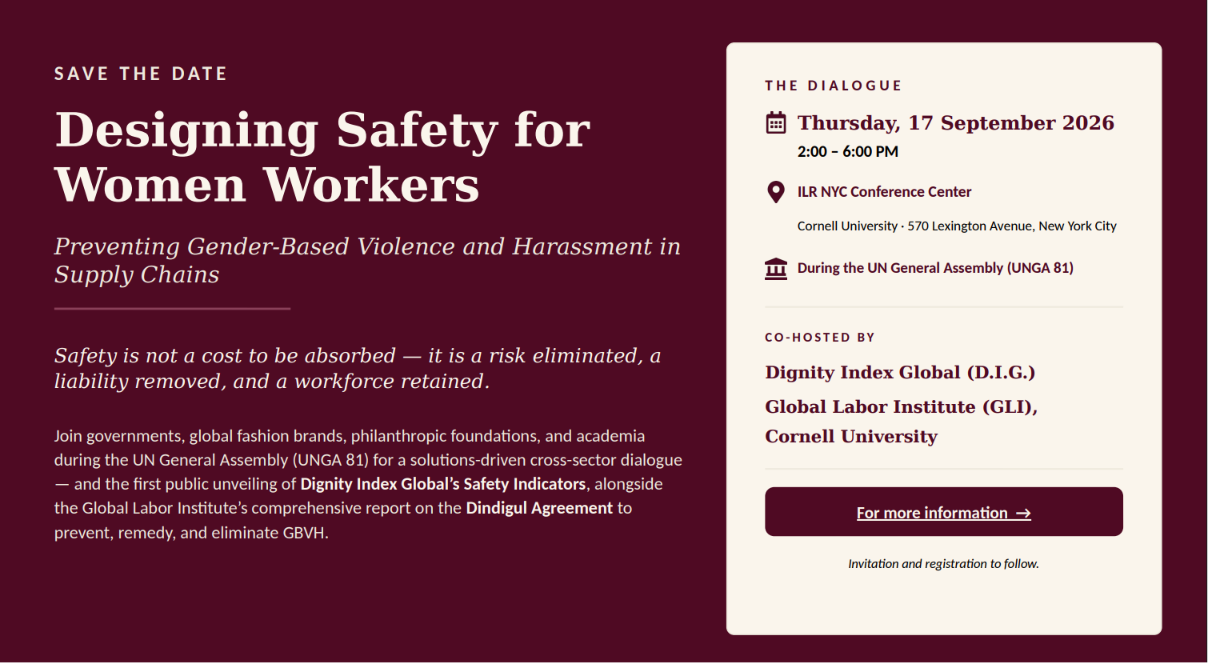
Save The Date
Designing Safety for Women Workers:
Preventing Gender-Based Violence and Harassment in Supply Chains
Thursday, September 17, 2026 | 2:00-6:00 PM
ILR NYC Conference Center, 570 Lexington Avenue, New York City
Background
In global supply chains, women do the work but carry the risk. They make up roughly 40 percent of the workforce, nearly 60 percent in the garment sector, rising to over 80 percent in some regions. Yet they frequently lack the social and legal protections that would shield them from gender-based violence and harassment (GBVH).
Current responses to GBVH in supply chains focus largely on raising awareness and responding to incidents through grievance mechanisms. These are essential, but insufficient. Too often, GBVH is treated as an isolated incident to be managed rather than a systemic failure to be dismantled, a reactive posture that manages harm instead of preventing it. This event calls for a different approach—proactive frameworks that treat women’s safety not as a problem to be handled after the incident, but as an inherent right to dignity, built in from the start.
Event Description
This half-day event co-hosted by Dignity Index Global (D.I.G.) and the Global Labor Institute (GLI) at Cornell University during the 81st Session of the United Nations General Assembly (UNGA 81), convenes governments, the global fashion industry, philanthropy, and academia, for a session on preventing GBVH and increasing safety in global supply chains.
The session will feature a multi-stakeholder interactive dialogue on cross-sector commitments to prevent GBVH and increase safety for women workers in supply chains. The panel, facilitated by a journalist, will bring together demand-and supply-side governments from the EU and Asia. It will also spotlight commitments by brands to move beyond the rhetoric of gender equality toward increasing safety in supply chains and showcase the role of philanthropy in shifting investment from responding to GBVH toward building safety, thereby supporting workers and their communities in the process. The Dindigul Agreement (a comprehensive assessment conducted by GLI at Cornell University) will serve as a case study, demonstrating what works and what doesn’t in addressing GBVH in supply chains. Dignity Index Global will speak to the need to increase and sustain safety as both a risk-mitigation measure and a driver of employee retention and a healthy workforce.
The session will also introduce Dignity Index Global's Safety Indicators, a structured framework grounded in ILO Convention 190, the UN Guiding Principles on Business and Human Rights, and Convention on the Elimination of All Forms of Discrimination Against Women (CEDAW), for measuring and sustaining safety across supply chains. More than a compliance tool, the Safety Indicators are built to be implemented — when put into practice, they mitigate risk, strengthen retention, and enhance productivity, proving that safety is not a cost but an investment. They raise the floor, so that every worker, community, factory, and brand can rise together.
The event will conclude with a reception featuring a keynote address from a senior UN official.